
Share Abstract
Preference for twice-yearly injections vs daily oral pills for HIV PrEP in cisgender men, transgender women, transgender men, and gender nonbinary people enrolled in PURPOSE 2
Abstract Content:
BACKGROUND: Daily oral pre-exposure prophylaxis (PrEP) is efficacious for HIV prevention; however, consistent adherence, a predictor of effectiveness, can be challenging, especially among some populations disproportionately affected by HIV. In the Phase 3 PURPOSE 2 trial (NCT04925752), twice-yearly subcutaneous (SC) lenacapavir lowered HIV incidence by 96% compared with background incidence and by 89% compared with oral emtricitabine'tenofovir disoproxil fumarate (F/TDF), with no safety concerns, in cisgender men, transgender women, transgender men, and gender nonbinary people who have sex with partners assigned male at birth. We present PrEP administration preferences reported among PURPOSE 2 participants.
METHODS: Participants were randomized 2:1 in a blinded fashion to receive SC lenacapavir every 26 weeks or oral F/TDF daily, plus an alternative injection/tablet placebo. During injection visits, participants completed an electronic questionnaire about PrEP administration preference (twice-yearly injections or daily pills) and how administration type impacts HIV risk perception and PrEP adherence. Data were collected at baseline (prior to injection), Week (W) 26, and W52. Categorical responses were analyzed descriptively.
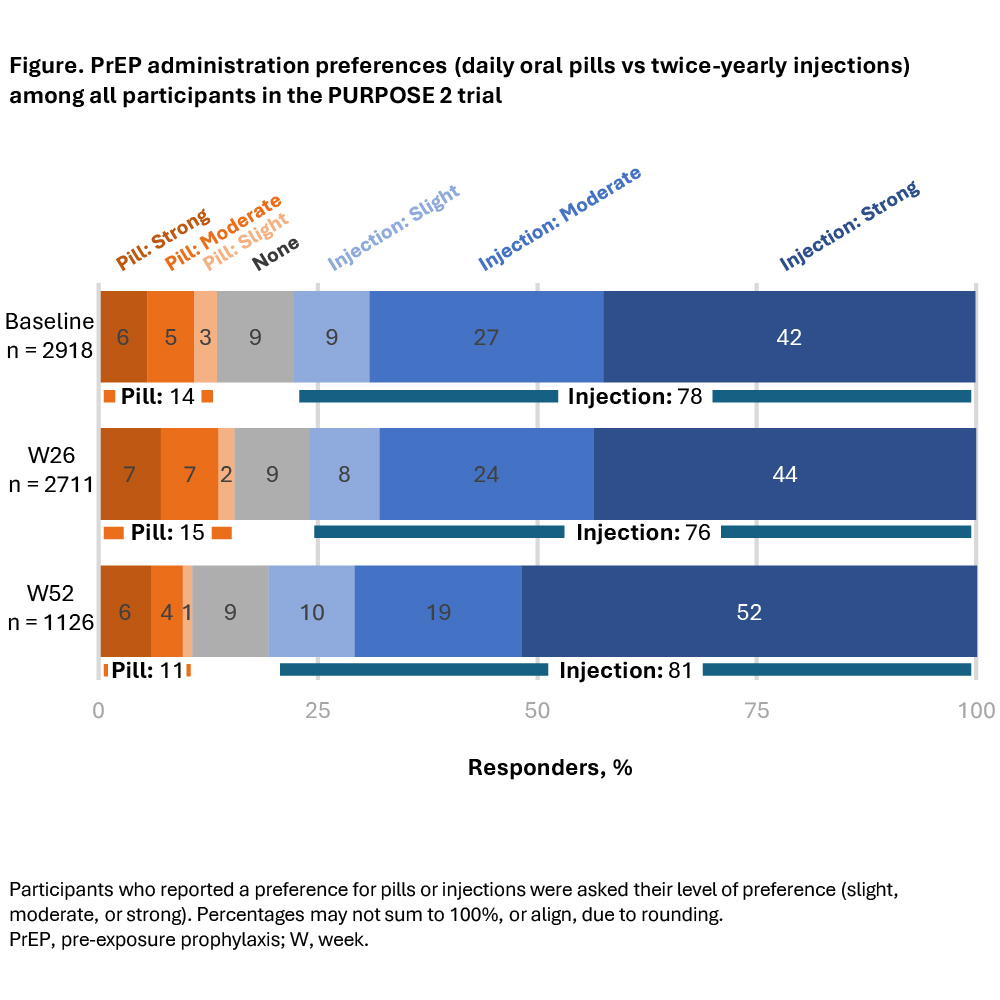
RESULTS: Of 3271 treated participants, 2918 and 1126 completed the questionnaire at baseline and W52 (primary analysis), respectively. Over 75% of participants preferred twice-yearly injections over daily pills; 11'15% preferred daily pills (Figure). Among those with a preference for injections, over half reported a strong preference. Most participants reported that they would feel more protected from HIV (baseline: 66%; W26: 66%; W52: 69%) and be more confident about not missing a dose (baseline: 76%; W26: 73%; W52: 77%) with twice-yearly injections versus daily pills. Results were generally consistent across geographies included in the trial.
CONCLUSIONS: Most participants preferred and felt more protected from HIV with twice-yearly injectable PrEP, although results highlighted the importance of choice. These data indicate twice-yearly lenacapavir could increase the uptake of, adherence to, and persistence with PrEP among men and gender-diverse people.
METHODS: Participants were randomized 2:1 in a blinded fashion to receive SC lenacapavir every 26 weeks or oral F/TDF daily, plus an alternative injection/tablet placebo. During injection visits, participants completed an electronic questionnaire about PrEP administration preference (twice-yearly injections or daily pills) and how administration type impacts HIV risk perception and PrEP adherence. Data were collected at baseline (prior to injection), Week (W) 26, and W52. Categorical responses were analyzed descriptively.
RESULTS: Of 3271 treated participants, 2918 and 1126 completed the questionnaire at baseline and W52 (primary analysis), respectively. Over 75% of participants preferred twice-yearly injections over daily pills; 11'15% preferred daily pills (Figure). Among those with a preference for injections, over half reported a strong preference. Most participants reported that they would feel more protected from HIV (baseline: 66%; W26: 66%; W52: 69%) and be more confident about not missing a dose (baseline: 76%; W26: 73%; W52: 77%) with twice-yearly injections versus daily pills. Results were generally consistent across geographies included in the trial.
CONCLUSIONS: Most participants preferred and felt more protected from HIV with twice-yearly injectable PrEP, although results highlighted the importance of choice. These data indicate twice-yearly lenacapavir could increase the uptake of, adherence to, and persistence with PrEP among men and gender-diverse people.