
Share Abstract
Lessons learned from the introduction of PEPFAR supported Long-Acting injectable Cabotegravir (CAB-LA) in shaping global prevention efforts
Abstract Content:
BACKGROUND: 1.3 million people acquired HIV in 2023, falling short of UNAIDS's goal of fewer than 370,000 individuals by 2025. In fiscal year (FY) 2024, PEPFAR supported 90% of global PrEP programming, and introduced long-acting injectable cabotegravir (CAB-LA) in Eswatini, Malawi, Ukraine, Zambia, and Zimbabwe. This analysis summarizes CAB-LA uptake, oral PrEP to CAB-LA switching, and the contribution of CAB-LA to overall PrEP uptake in the first year of introduction.
METHODS: PEPFAR Monitoring, Evaluation, and Reporting (MER) indicators PrEP_NEW (PrEP naive individuals initiated on PrEP) and PrEP_CT (individuals returning or re-initiating PrEP at least once that quarter), disaggregated by PrEP type were analyzed. FY24 results were restricted to quarters that CAB-LA was available. The number of individuals returning for PrEP was averaged across quarters that CAB-LA was available in all five countries. Switching from oral PrEP to CAB-LA was only measured in the first quarter CAB-LA was introduced in each country using PrEP_CT.
RESULTS: Across all five countries, 441,269 individuals initiated PrEP and, on average, 127,292 returned for PrEP when both PrEP options were available. In FY24, 3,772 PrEP-naive individuals initiated CAB-LA, and 900 switched from oral PrEP to CAB-LA in the first quarter of CAB-LA introduction. Eswatini, Malawi, and Zambia reported more PrEP-naive individuals initiated on CAB-LA, compared to individuals switching from oral PrEP to CAB-LA. Compared to the same quarters in FY23, CAB-LA introduction correlated with a 25% increase in PrEP initiations and a 33% increase in PrEP return.
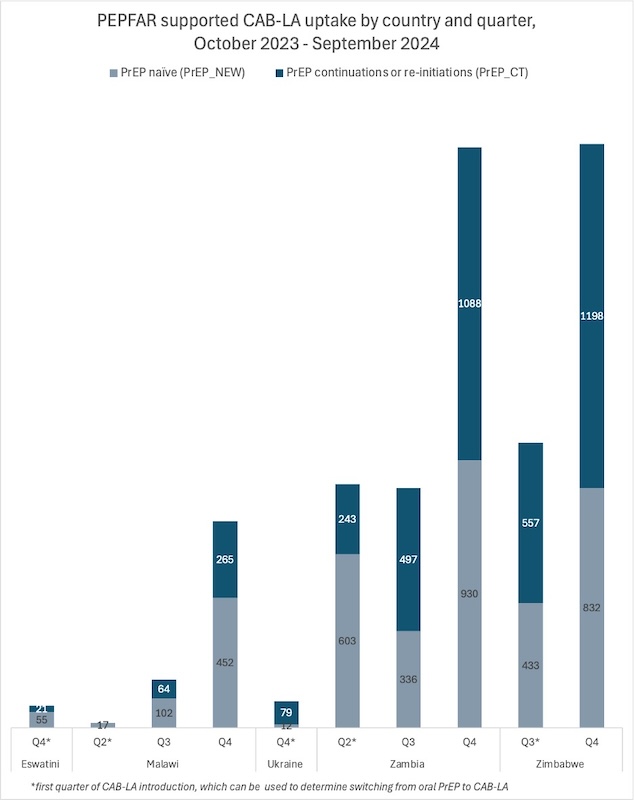
CONCLUSIONS: PEPFAR has been instrumental in introducing and scaling new prevention products worldwide. The introduction of CAB-LA demonstrates the potential to increase uptake and reach PrEP-naive populations across countries. By diversifying prevention options, CAB-LA complements oral PrEP programming and catalyzes PrEP uptake, enabling broader coverage. Lessons learned from early introduction informs scale-up and expansion of long-acting PrEP (LA-PrEP), including CAB-LA and Lenacapavir. With HIV at the cusp of epidemic control, interruptions in PEPFAR financing undermines gains made over the past two decades, results in significant delays in introducing and scaling LA-PrEP, and limits access to life-saving prevention for populations at high risk of HIV acquisition.
METHODS: PEPFAR Monitoring, Evaluation, and Reporting (MER) indicators PrEP_NEW (PrEP naive individuals initiated on PrEP) and PrEP_CT (individuals returning or re-initiating PrEP at least once that quarter), disaggregated by PrEP type were analyzed. FY24 results were restricted to quarters that CAB-LA was available. The number of individuals returning for PrEP was averaged across quarters that CAB-LA was available in all five countries. Switching from oral PrEP to CAB-LA was only measured in the first quarter CAB-LA was introduced in each country using PrEP_CT.
RESULTS: Across all five countries, 441,269 individuals initiated PrEP and, on average, 127,292 returned for PrEP when both PrEP options were available. In FY24, 3,772 PrEP-naive individuals initiated CAB-LA, and 900 switched from oral PrEP to CAB-LA in the first quarter of CAB-LA introduction. Eswatini, Malawi, and Zambia reported more PrEP-naive individuals initiated on CAB-LA, compared to individuals switching from oral PrEP to CAB-LA. Compared to the same quarters in FY23, CAB-LA introduction correlated with a 25% increase in PrEP initiations and a 33% increase in PrEP return.
CONCLUSIONS: PEPFAR has been instrumental in introducing and scaling new prevention products worldwide. The introduction of CAB-LA demonstrates the potential to increase uptake and reach PrEP-naive populations across countries. By diversifying prevention options, CAB-LA complements oral PrEP programming and catalyzes PrEP uptake, enabling broader coverage. Lessons learned from early introduction informs scale-up and expansion of long-acting PrEP (LA-PrEP), including CAB-LA and Lenacapavir. With HIV at the cusp of epidemic control, interruptions in PEPFAR financing undermines gains made over the past two decades, results in significant delays in introducing and scaling LA-PrEP, and limits access to life-saving prevention for populations at high risk of HIV acquisition.