
Share Abstract
Assessing the impact of USG funding cuts on Zambia's HIV programming: a retrospective review of PrEP and VMMC uptake (2024'2025)
Abstract Content:
BACKGROUND: Zambia has made strides in reducing the HIV burden with incidence having declined from 0.61% in 2016 to 0.31% in 2021 among the general population aged 15-49 years (ZAMPHIA). Zambia's commitment to curb HIV has seen roll-out of programs such as Voluntarily Medical Male Circumcision (VMMC), oral and injectable Pre-exposure prophylaxis (PrEP). These programs have expanded rapidly largely due to the support from the United States Government (USG). This analysis assesses the impact of USG funding disruptions on PrEP and VMMC in Zambia.
DESCRIPTION: A retrospective analysis of secondary data from DHIS2, the Ministry of Health's national data system, was conducted to assess uptake in oral PrEP and VMMC services, comparing Q1 2024 to Q1 2025. The analysis focused on quarterly changes in uptake across geographies with cross-tabulations and trend analysis used to identify performance implementation gaps and emerging patterns.
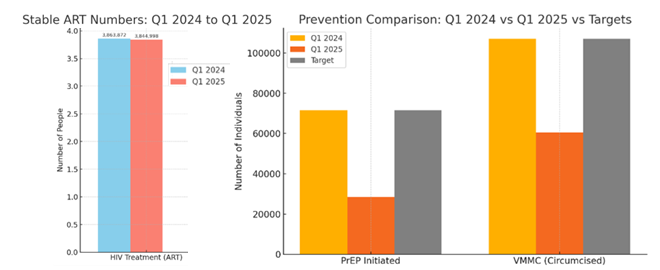
LESSONS LEARNED: The HIV treatment program showed stability compared to the sharp declines in prevention. Between January-March 2024 and the same period in 2025, the number of individuals on ART declined marginally by just 0.5% (from 3,863,872 to 3,844,998). In contrast, oral PrEP initiations dropped from 71,608 in Q1 2024 to 28,230 in Q1 2025, a 60.6% decrease. This performance was 51% below the quarterly target of 58,120. VMMC services saw a similar drop from 107,034 individuals in Q1 2024 to 60,546 in Q1 2025, a 43.4% decline, achieving just 49.5% of the quarterly target of 144,589.
 '
'
CONCLUSIONS: USG funding cuts have disrupted Zambia's HIV prevention programs, particularly in USAID-supported provinces, leading to reduced uptake of PrEP and VMMC, threatening broader epidemic control. Urgent action is needed to assess the full impact of the disruptions to inform government-led efforts to sustain services through domestic resource mobilization, reprioritization to ensure continuity, and robust monitoring systems to build resilience against external shocks
DESCRIPTION: A retrospective analysis of secondary data from DHIS2, the Ministry of Health's national data system, was conducted to assess uptake in oral PrEP and VMMC services, comparing Q1 2024 to Q1 2025. The analysis focused on quarterly changes in uptake across geographies with cross-tabulations and trend analysis used to identify performance implementation gaps and emerging patterns.
LESSONS LEARNED: The HIV treatment program showed stability compared to the sharp declines in prevention. Between January-March 2024 and the same period in 2025, the number of individuals on ART declined marginally by just 0.5% (from 3,863,872 to 3,844,998). In contrast, oral PrEP initiations dropped from 71,608 in Q1 2024 to 28,230 in Q1 2025, a 60.6% decrease. This performance was 51% below the quarterly target of 58,120. VMMC services saw a similar drop from 107,034 individuals in Q1 2024 to 60,546 in Q1 2025, a 43.4% decline, achieving just 49.5% of the quarterly target of 144,589.
CONCLUSIONS: USG funding cuts have disrupted Zambia's HIV prevention programs, particularly in USAID-supported provinces, leading to reduced uptake of PrEP and VMMC, threatening broader epidemic control. Urgent action is needed to assess the full impact of the disruptions to inform government-led efforts to sustain services through domestic resource mobilization, reprioritization to ensure continuity, and robust monitoring systems to build resilience against external shocks