
Share Abstract
Termination of the USAID APACE award in Johannesburg, South Africa: impact on the number of people living with HIV tested, diagnosed and initiated on anti-retroviral therapy (ART) (January-March 2023-2025)
Abstract Content:
BACKGROUND: The United States President's Emergency Plan for AIDS Relief (PEPFAR), through USAID, funded the Accelerating Program Achievements to Control the HIV Epidemic (APACE) award. The purpose of the award was to support the Department of Health to achieve the 95-95-95 goals in Johannesburg District (JHB), with an estimated 623,200 adults living with HIV. APACE activities in JHB ceased immediately following the Stop Work Order on 21st January, with the award terminated in February 2025.
METHODS: Routine indicators'HIV tests, HIV positive diagnoses, and ART initiations'were compared across Q1 2023 to 2025 to account for seasonal variation. HIV positivity and initiation rates were calculated. Clinicians recorded visits in standardized paper-based stationery, with data entered in TIER.Net and exported to WebDHIS, from which data was extracted in April 2025.
RESULTS: HIV testing decreased by 8.5% from Q1 2024 to Q1 2025, with a 31% reduction in HIV diagnosis and 30% reduction in ART initiations. HIV positivity declined from 3% to 2.2% while the ART initiation rate remained stable at 81-82%. Figure 1 shows monthly data for Q1 2023-2025.
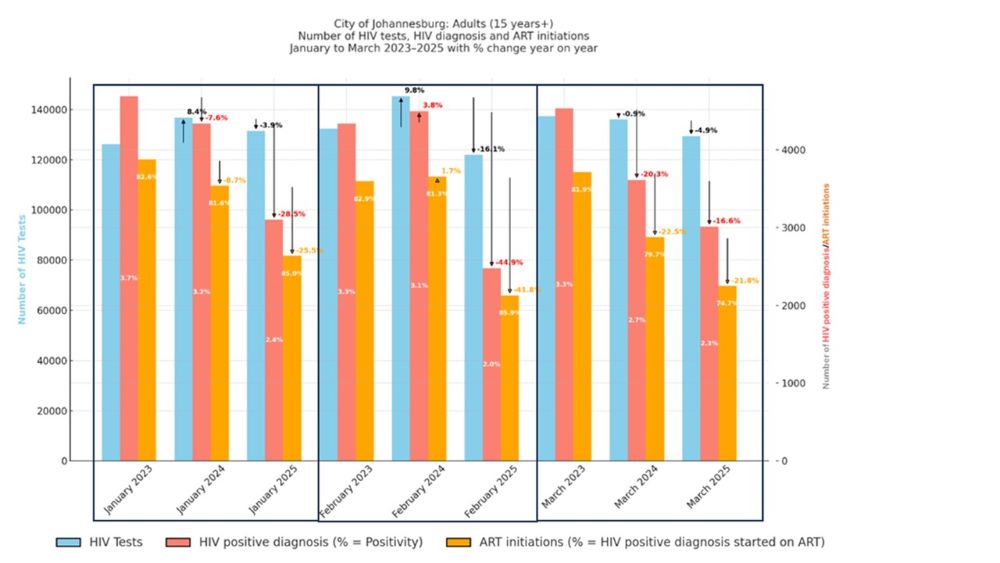
CONCLUSIONS: Termination of USAID support resulted in fewer HIV tests and substantially greater reductions in HIV diagnoses and ART initiations in Q1 2025. This likely reflects the loss of key healthcare workers, including counsellors providing index and targeted community-based HIV testing to people most vulnerable to HIV acquisition. The loss of data capturers impaired data capturing and monitoring. While some under-capture of HIV tests is possible, the sharper declines in diagnoses and initiations are considered reliable. Loss of technical support for data analysis and use has also weakened health facilities'' ability to respond to the rapidly declining numbers of people living with HIV diagnosed and initiated on ART.
METHODS: Routine indicators'HIV tests, HIV positive diagnoses, and ART initiations'were compared across Q1 2023 to 2025 to account for seasonal variation. HIV positivity and initiation rates were calculated. Clinicians recorded visits in standardized paper-based stationery, with data entered in TIER.Net and exported to WebDHIS, from which data was extracted in April 2025.
RESULTS: HIV testing decreased by 8.5% from Q1 2024 to Q1 2025, with a 31% reduction in HIV diagnosis and 30% reduction in ART initiations. HIV positivity declined from 3% to 2.2% while the ART initiation rate remained stable at 81-82%. Figure 1 shows monthly data for Q1 2023-2025.
CONCLUSIONS: Termination of USAID support resulted in fewer HIV tests and substantially greater reductions in HIV diagnoses and ART initiations in Q1 2025. This likely reflects the loss of key healthcare workers, including counsellors providing index and targeted community-based HIV testing to people most vulnerable to HIV acquisition. The loss of data capturers impaired data capturing and monitoring. While some under-capture of HIV tests is possible, the sharper declines in diagnoses and initiations are considered reliable. Loss of technical support for data analysis and use has also weakened health facilities'' ability to respond to the rapidly declining numbers of people living with HIV diagnosed and initiated on ART.